The Artistic Intersection of Japan and Europe
The 19th century saw a significant rise in the influence that Japanese art had over European art. Japanese artwork and the avant-garde styles of the European impressionists would cross-pollinate in the late 19th century, forming an artistic bridge that transcended national boundaries and cultures. This fusion of art would come to be known as Japonism.
What was the impact of this artistic mingling between two geographically distant, yet culturally rich societies? How did the European impressionists and post-impressionists incorporate the traditional, distinctly Japanese style and motifs into their own artwork? Let’s take a look at how Japanese art influenced the European impressionist movement and how this heavy exchange created a style the world continues to admire today.
The Discovery of Japanese Art by European Artists
In the early 19th century, Japan had been a closed nation for two centuries. The only access to the country from Europe at the time was through Dutch and Chinese trading vessels. However, in 1853, the American commodore Matthew Perry forcibly entered the country to garner a trade agreement, followed by a series of treaties and agreements with other countries, leading to the opening of Japan to the world. This was the first time that Japanese art was truly exposed to the West; it created an immense enthusiasm amongst artists in Europe.
The Japanese aesthetic was novel to the Western world; it was structured by a spirit of naturalism, simplicity and artless grace which sharply contrasted with the heavily stylized, over-the-top artistic tropes found in European art at the time. Suddenly, the European artists had access to a culture, at once entirely removed from their own, yet somehow familiar, as if it was a forgotten dream from an ancient culture.
Ukiyo-e Prints and the Post-Impressionists
The woodblock prints known as ukiyo-e were an immediate source of inspiration for the European impressionist artists. These highly detailed prints were incredibly accessible for contemporary European artists. Artists such as Vincent Van Gogh especially noted the mercurial lines and structures found in the ukiyo-e prints; these free-flowing brushstrokes and sparse backgrounds would become a primary motif in the post-impressionist style.
In addition to the visual sense of freedom found in the ukiyo-e prints, the Japanese visual motif of flatness was also adopted by the European impressionists. By creating a series of flat planes and shapes, Japanese visual artists were able to create a space that was both real and illusory, where figures and landscapes melded and coalesced. Monet, Gauguin, and Van Gogh would adopt the idea of flatness, creating landscapes and still lifes which would blur the line between solidity and fragility.
Zen Aesthetics and the Expressionists
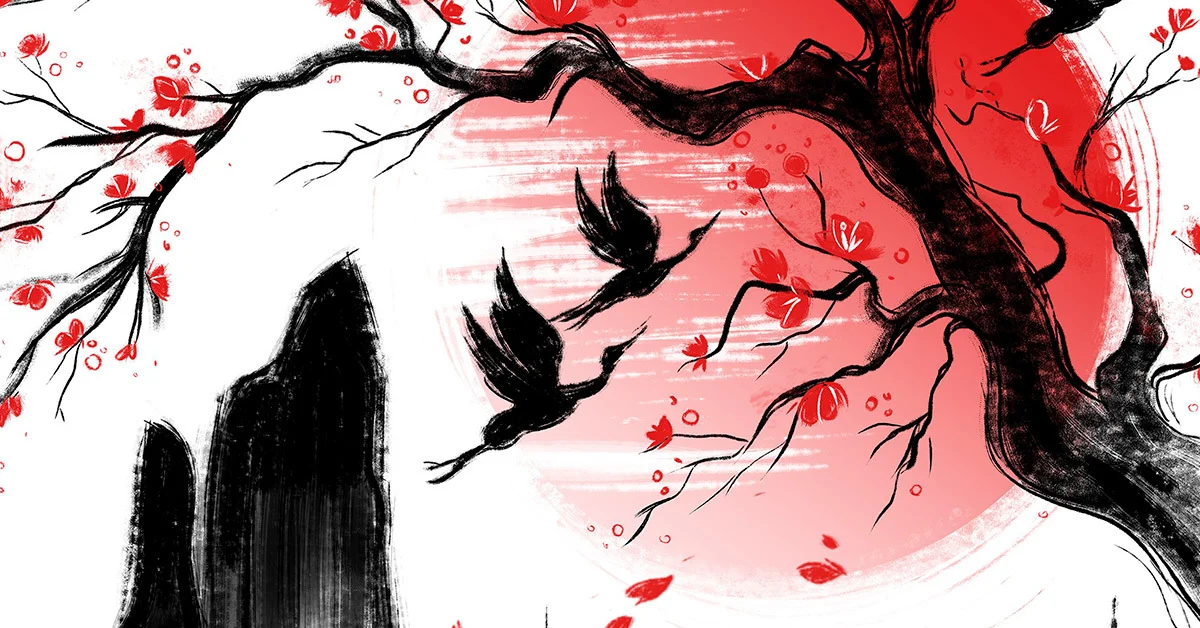
In the latter portion of the 19th century, European artists were also exposed to the more spiritual side of Japanese art. This was found particularly in the Zen Buddhist aesthetic found in many of the era’s well-known works. The underlying message of Zen aesthetics can vary from artist to artist, however, a few core motifs can be seen recurring throughout the works. Zen aesthetics focused on freedom from worldly desire, inner balance of the mind, and a relinquishing of ego.
These ideas were embraced by the European expressionists, most notably the German artists of the school. This appreciation for the more spiritual side of Japanese artwork inspired many of the psychological expressionist paintings of the era such as Erich Heckel’s The Evil God, which conveyed the contradictions inherent in Zen philosophy.
The Resonance of Nature in Japanese and European Art
The emphasis found in Japanese artwork on the power of natural simplicity thoroughly impressed the European artist. Whereas the Europeans of the era focused heavily on the strict, Renaissance ideal of form and structure, the Japanese art from the period focused on a more loose and intuitive style. By emphasizing the beauty of nature, artists sought to depict it in its purest, most natural form.
The artist Hokusai was known for his detailed, yet lighthearted sketches of everyday scenes. The playful and childlike serenity of his work was embraced by the impressionists, particularly those that painted the landscapes of Provence such as Monet and Pissarro. Hokusai’s attitude toward nature was embraced by the late 19th-century French impressionists, who sought to bring the same sense of whimsy and subtle natural beauty to the outside world.
The influence of Japanese art on the European impressionist movement of the 19th century was undeniable. Japanese artwork of the time provided a much-needed escape from the highbrow, academic rules of European art. The impressionists, including Monet, Pissarro, and Van Gogh, found solace in the often whimsical, intuitive style of the Japanese art form. Merging a harmonious balance between the European’s Western-style art and the Eastern-style art of Japan, the impressionist movement created an incredibly unique fusion of two entirely different artistic traditions. This amalgamation of two distinct worldviews, seen both in the painstakingly detailed woodblock prints of Hokusai, as well as the free-flowing and spiritual artwork of Zen Buddhism, would become some of the most influential works of art the world has seen, and a testament to the power of the human capacity for creative expression.